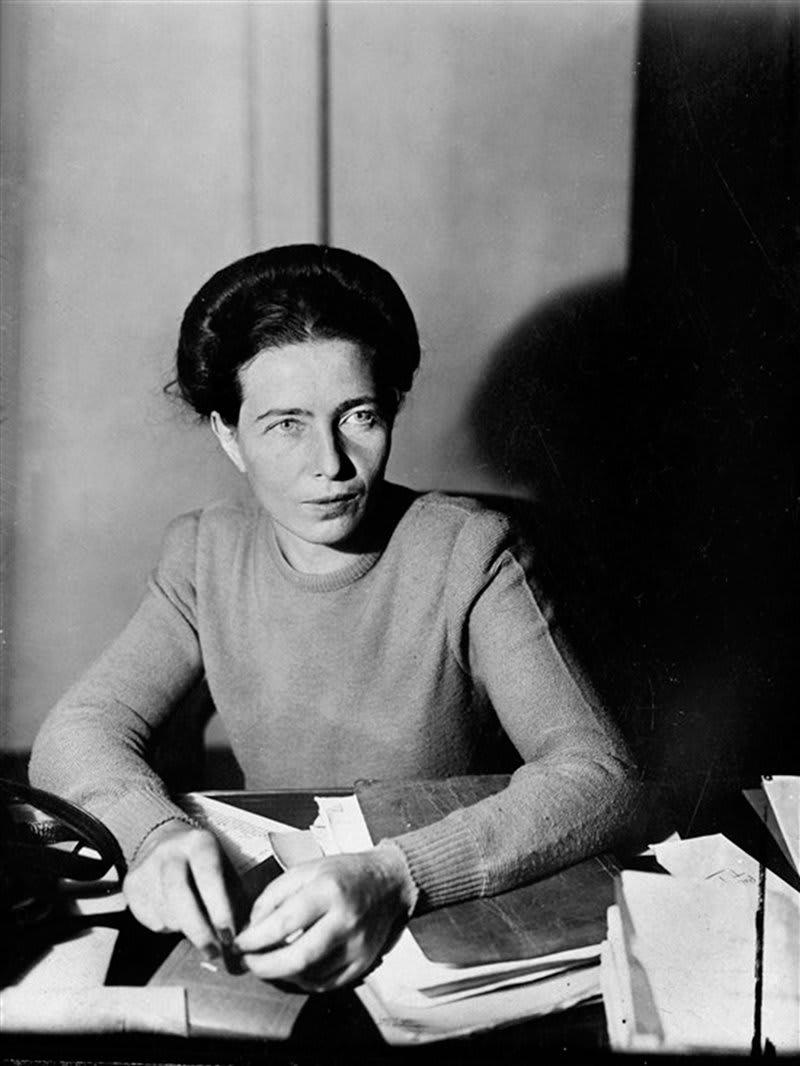
"One is not born, but rather becomes, a woman"
This famous quote from her masterpiece, "The Second Sex" (1949), encapsulates the core of her teachings. De Beauvoir explained to women worldwide that "femininity" is not a biological destiny or a natural prison, but a social construct. With this book, she laid the foundations of modern feminism, inviting every woman to reclaim her identity outside the structures imposed by patriarchal society.
The Pillars of Independence: Economics and Emotion
Simone de Beauvoir was a pioneer in emphasizing that women’s autonomy must rest on two fundamental pillars. For De Beauvoir, work is not merely a duty but the primary tool for liberation. Without the ability to support herself financially, a woman will always remain, to some extent, subordinate to a man's will.
She taught that love should not be a form of slavery or self-erasure. Her own life, lived through open and intellectually equal relationships, proved that one can love deeply without losing oneself.
A Legacy of Literature and Activism
From the pages of The Mandarins (winner of the Prix Goncourt in 1954) to her memoirs (Memoirs of a Dutiful Daughter), her work is a constant call to individual responsibility. She taught us that freedom comes at a price—requiring courageous and often counter-cultural choices—but that it is the only path to an authentic existence.
Remembering Simone de Beauvoir this April in Paris means recognizing that her battles are still ours. In an era of new challenges for civil rights, her analysis of the female condition remains an essential compass. She reminds us that independence is not a final destination, but a daily practice of awareness.
"May nothing bind us, may nothing define us, may nothing chain us. May freedom be our very substance."