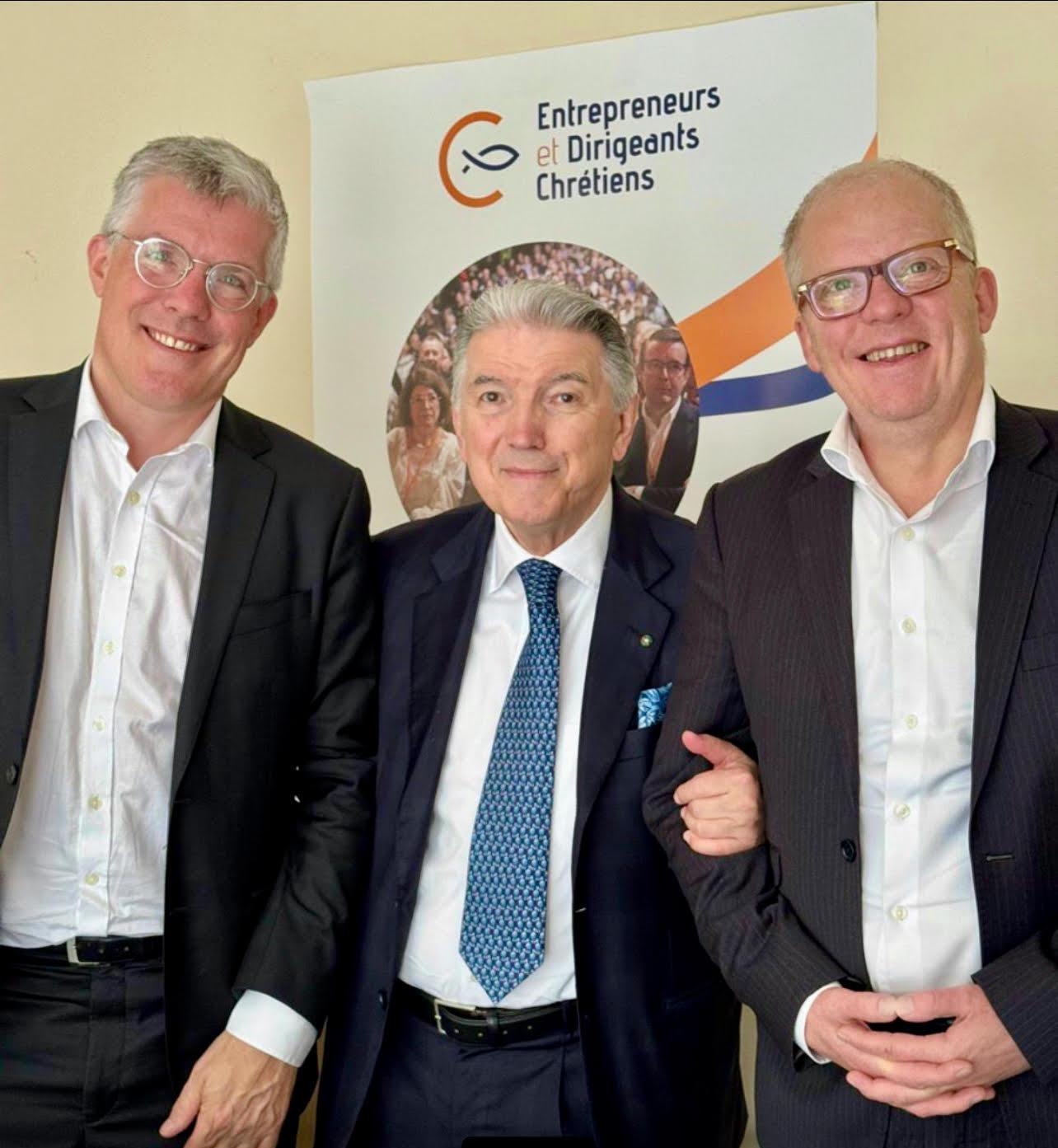
The institutional mission provided a high-level platform for bilateral discussions with the sector’s leading global organizations: Uniapac, the worldwide federation coordinating Christian business associations across more than 60 countries, and EDC (Entrepreneurs et Dirigeants Chrétiens), France's historic and deeply rooted Christian business association. In Paris, Storchi met with the newly elected national president of EDC, Arnaud Guirouvet, and the secretary general of Uniapac, Rodrigo Whitelaw, launching a working agenda centered on integral humanism, labor ethics, and corporate social sustainability.
The Paris talks allowed the Italian delegation led by Storchi to closely analyze EDC's extraordinary inclusive power. While Italy’s UCID is historically anchored in the Catholic tradition, its French counterpart has successfully created a true ecumenical laboratory at the continental level. EDC permanently unites three major European Christian denominations under the same banner and at the same operational tables: Catholics, Orthodox, and Protestants.
In France, historic dogmatic barriers are overcome by a strong, pragmatic convergence on the value of work, the centrality of the human person, and ecological responsibility. For UCID, this approach represents a model of interreligious dialogue to be studied closely in order to provide a unified response to modern geopolitical and economic crises.
The trilateral summit between UCID, Uniapac, and EDC yielded clear, shared strategic guidelines, which will translate into concrete actions in the coming months:
Ethical Governance of Artificial Intelligence: Applying the principles of algoethics to ensure that technological innovation and predictive systems remain tools at the service of humanity, rather than drivers of alienation or job insecurity.
Human Protection in Manufacturing Processes: Re-centering the value and skills of employees within industrial strategies, recognizing them as the primary asset of the modern factory.
Training and Civil Economy: Investing in the next generation of managers by establishing permanent cultural and scientific collaboration between Italy and France. The plan includes periodic meetings, joint research projects, and editorial initiatives focused on ethical leadership.
"France demonstrates a powerful ability to build a cohesive system and tackle economic and social challenges collectively," stated Fabio Storchi on the sidelines of the meetings. "European dialogue between Christian business associations can decisively contribute to building a more humane, equitable, and sustainable development model."
The need for ethical leadership and long-term vision raised by UCID resonates deeply in a contemporary Paris that is experiencing an underlying period of institutional nostalgia. Faced with a highly polarized electorate, fluid parliamentary majorities, and governments often forced to manage by sight, the citizens of the Ville Lumière look back wistfully to the era of the Great Presidents of the Fifth Republic.
This collective nostalgia turns toward two titanic figures—historic rivals, yet mirrors of each other in their vision of state stability and grandeur: François Mitterrand and Jacques Chirac. The 1995 transition marked the end of an era when, despite sharp institutional cohabitations, respect for the public apparatus and a deep-seated love for the capital were unquestionable.
Paris still bears the marks of that extraordinary capacity for centralized and cultural planning that citizens miss today as a symbol of lost solidity. Walking along the Seine, between I.M. Pei’s Louvre Pyramid and the Quai Branly structures, Parisians do not see mere museum attractions today, but rather monuments of an era when political parties were deeply rooted and national policy advanced with the heavy, confident, and unifying step of giants.
This widespread demand for stable reference points and solid values is exactly what UCID’s new international mission aims to address—translating it into economic and business terms within the core of European associational dynamics.